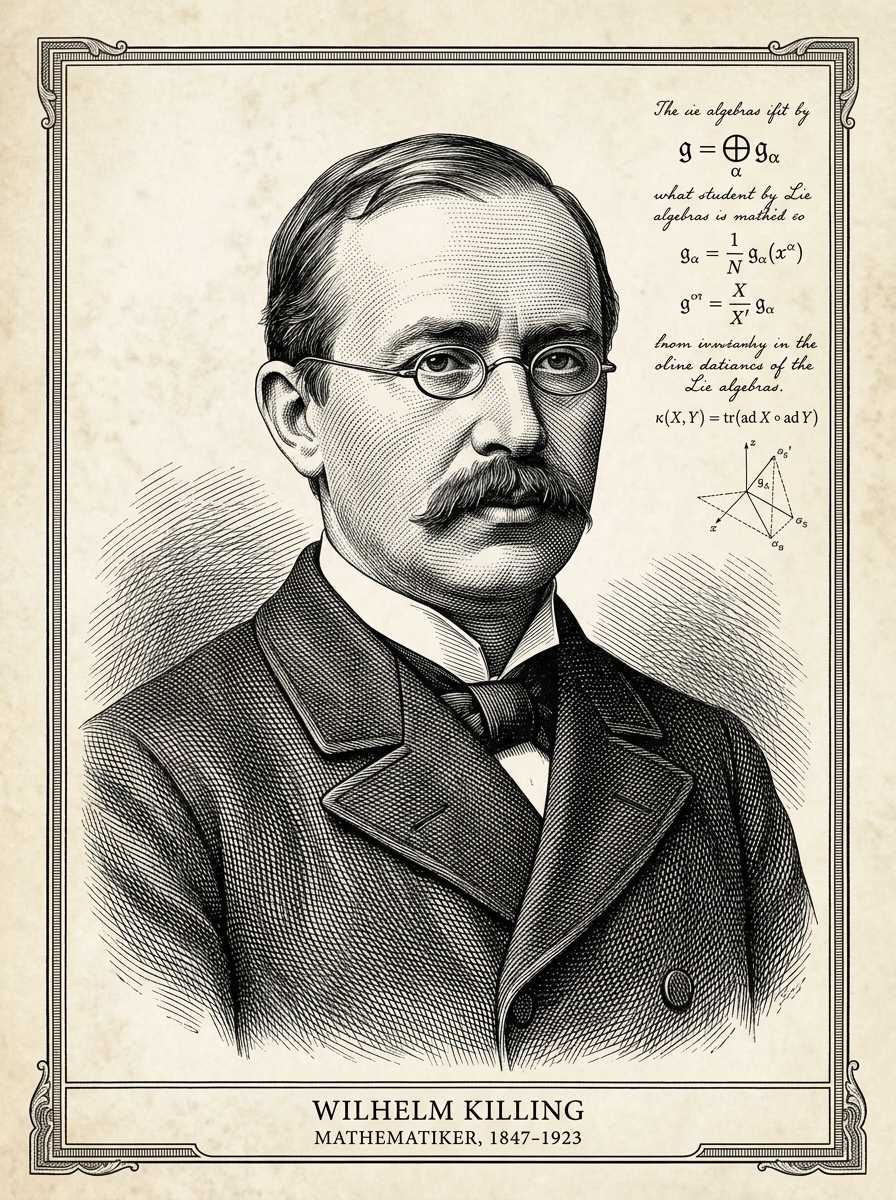
Every set of symmetry rules has a built-in diagnostic. You compute it; you don't choose it.— Based on Killing's 1888 work and Cartan's later development
The Killing form, rooted in Killing's 1888 work and developed centrally by Cartan, is the mathematical tool that unlocks the proof Einstein was looking for.
The Killing form is not a tool that physicists borrowed from mathematics. It is a property that the symmetry algebra itself possesses: a built-in self-assessment. When applied to the algebra of spacetime symmetries, it issues a verdict on which universe is algebraically consistent.
The Mathematical Instrument
What Is the Killing Form?
For any two symmetry generators X and Y, the Killing form computes a number that measures how 'big' or 'visible' those generators are within the algebra. It's an inner product on the space of symmetries.
Take your symmetries
The algebra of spacetime transformations has generators: rotations J and boosts K. These are the building blocks of every possible symmetry transformation.
Compute the adjoint maps
For each generator X, compute the adjoint map adₓ, a linear operator that encodes how X interacts with everything else in the algebra via the bracket [X, −].
Take the trace
Compose the two adjoint maps and take the trace of the resulting matrix. The number you get is B(X, Y), the Killing form value for those two generators.
The remarkable thing:the Killing form is completely determined by the algebraic structure. You don't get to choose it. Given the symmetry rules, the form is fixed. This is what makes it a diagnostic rather than a parameter.
The Verdict
What the Killing Form Tells Us
The Euclidean Universe
The Killing form is negative-definite. All generators are visible, but there is no distinction between space and time. No lightcone. No causal ordering. Physics is impossible without a before and after.
The Galilean Universe
The Killing form is degenerate: B(boosts) = 4κ = 0. The form cannot see the boost generators at all. The algebra has a blind spot. The self-test fails. Newton's universe is algebraically incomplete.
The Lorentzian Universe
The Killing form is non-degenerate. B(rotations) = −4 < 0 (always), B(boosts) = 4κ > 0. All generators are visible. An invariant speed V = 1/√κ emerges. The algebra is self-consistent and complete.
"The sign of κ is not a choice. It is a consequence."
The Killing form, computed from the symmetry rules alone, determines which universe is algebraically consistent. Only κ > 0 works. And from κ > 0, the invariant speed V = 1/√κ follows without any additional postulate. This is what Postulate II was hiding.